Saturday, May 29, 2021

Glow in the Dark Squid and Water Bears

 Squid are some of the most fascinating creatures in the maritime realm.  I once was able to identify some formerly frozen squidlings who had been captured in frozen ice cores in the Arctic when I took a Sea Ice course through the University of Fairbanks in Barrow, AK.  Looking for seal haul out locations with their pups and going out on the ice shelf to experience the beluga whale migration were all very rewarding, but finding those little guys in an ice core was also very satisfying.

That's why I was so drawn to this story my hubby shared with me this morning.  Some amazing squid will be taking a trip to space to help increase our knowledge of ________.


squids in space! 

Saturday, May 28, 2016

Saturday, May 7, 2016

Magma..... Oooooooo.....

What lies below: swarm of earthquakes detected beneath Mount St Helens http://gu.com/p/4jxv4?CMP=Share_AndroidApp_Blogger

Wednesday, May 4, 2016

Great football story

The Leicester Supremacy – a triumph that was never supposed to happen http://gu.com/p/4tnbp?CMP=Share_AndroidApp_Blogger

Wednesday, February 24, 2016

Pscylla and Charybdis - A tale of pot holes & erratic driving

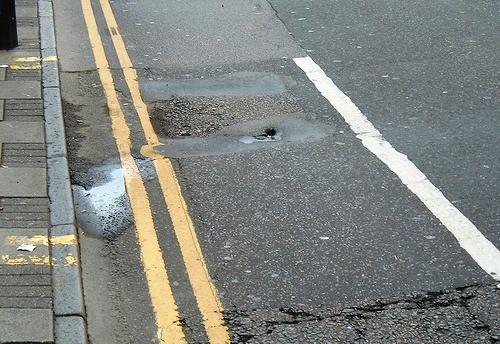
I have lived in eight states since I was able to legally get behind the wheel of a car.  My jobs always required me to do a moderate amount of travel by car.  I have not experienced worse roads until I was stationed in the state which boasts it is the home of the motor city.  More affluent cities and townships can and do ensure that the road repairs are fairly prioritized to the worst conditions getting altered first.

Road in need of repair.
This is a mild example

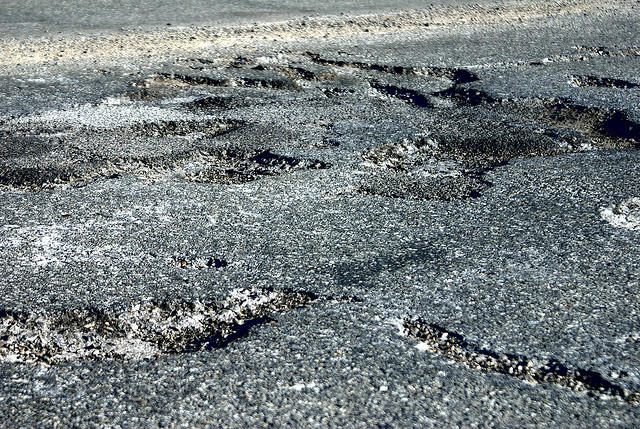
Michigan roads
This one looks more like a really angry sea than an urban road


However, it seems that this practice is not within reach of all municipalities.  Our house is about 3 miles away from the main thoroughfare, I-94.  Drivers (myself included) spend a lot of time dodging the ever changing potholes and sinkholes.  Is this a conspiracy between the state and the repair shops to drum up more business?  I am just kidding.

The Ann Arbor public radio station has a great commentator who always has something pithy and funny to say about the politicians in Lansing.  One proposal about a fix was to increase auto registration fees %20, to decrease the impact on the budget, which had a big surplus this year.
I will let you come to your own conclusion about the fairness of that.

Being a retired USCG person, I am glad to say that the state of the waterways and their markers is much better.  Of course Governor Snyder has nothing to do with the conditions of the lakes and rivers that cover most of Michigan.  The element that creates danger, is the individual boaters and their lack of respect for Mother Nature and education about the Nautical Rules of the Road.  

Navigation Rules International Inland
You can download the manual at this link


Tuesday, February 23, 2016

I love snow and ice!!!

Climate change is on my mind as I alternate between morning infotainment of the sports and news varieties.

I was cleaning the kitchen and I listened to a relay of Science Friday thru my Roku* and the Tune In streaming channel.  It was a great show, as usual.

It reminded me of part of the curriculum of my graduate program at the Dub.  At that time it was in the School of Marine Affairs.  Don't get me started on all the goofy questions you get when you tell someone that you got a masters degree in Marine Affairs.  They need to change that at some point....

My advisor was one of the members of the Intergovernmental Panel on Climate Change.
He always had interesting stories about some of the debates that went on during those meetings.  Would have been fun to be a fly on the wall for some of those...

Years later I was working in Alaska in fisheries management.  I lived in Juneau, where the land was rebounding based on the retreat of the glaciers.  Good for the people who owned home, bad for the boaters who were navigating by landmarks or GPS only, when it came to depth soundings.  I love tides, it makes the boaters more educated about mother nature.

In some northern parts of the state, some of which I had visited as part of my job, you find the zones where  polar bears and walrus were quite common.

Since I spent some time holding the rifle for 'polar bear watch' while up in Barrow taking a sea ice research class, I will just tell you a little about their conditions based on the recent decreases in the amount of sea ice in the arctic.

I have toured the holes that the seals make in the ice so that they can come up to breathe.  The polar bears depend on the existence of these holes to hunt during the coldest part of the year.  I was in Barrow for a few weeks in May, so the ice was still fairly thick.  A few months later would be entirely different.  The whalers could still use their subsistence whale allowances (bowhead, primarily) to hunt in the summer, but the polar bears are not so lucky.


That is why you see a lot of pictures like the one above.  This bear is either incredibly dirty, or it could be a hybrid between a grizzly and a polar bear.  The point is that both humans and other animal will be affected by climate variability, and we need to be aware of its consequences.

Sunday, February 21, 2016

Aquarium Update

Our little piece of ocean here in the midwest resides in the basement.  We have a 29 gallon salt water aquarium which has hosted a wide variety of sea creatures.

The current inhabitants are a couple turbo snails, one bumble bee snail, and a pencil urchin

We used to have three of these guys, but they didn't survive the cross country move, and or the long spined urchin that ate itself into an early watery grave.


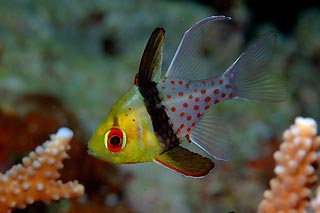
Pajama Cardinalfish
Pajama Cardinal Fish - borrowed from this cool blog


I guess as of wednesday I should say ONE turbo snail.  The big one was about 5 cm in diameter, but I think it has been dispatched by the urchin.  This is the second urchin we have hosted, and though they are supposed to be tank cleaners and vegetarians, they both eventually decided that the occasional meat dinner.

I eventually want to turn that aquarium into coral setting, so the urchin will have to be turned back into the fish store for credit.

For some other salty creatures I have desired or hosted, please check out my other blog.

Monday, December 29, 2014

Historic naming of places and objects

I have always appreciated the practice of naming ships and places based on the history of any group.


One of my favourite U.S. Coast Guard Lighthouse Keepers is Ida Lewis.  This modern buoy tender was christened as a tribute to one of the great women in Coast Guard history.

Borrowed from the USCG website
Military and law enforcement agencies are particularly fond of this method, as they are interested in preserving their heritage over long periods of time.  Longtime residents of towns also end up confusing the newcomers by using the former names that were passed down from their predecessors. Most of the structures and landmarks are still there, but they are no longer fulfilling their intended purpose.

I experienced several examples of this when I was stationed in Alaska.  I remained confused for at least 6 months as I tried to memorize the names and locations of various landmarks.  My favourites in the state capitol were the Sub Base, the end of the road, Sheep Creek and the Ore House.

(borrowed from Urban Spoon link)
The Ore House was a great place to have a work party.  The food was great, the atmosphere was rustic, and the tourists didn't get far south on the mainland.  Being a nautical person, I thought it was the Oar House and was named after a traditional location for  launching canoes or kayaks.  My friends got a lot of laughs out of that blunder, and reminded me that Juneau got on the maps drawn by non-native folks lured by gold and other resources.

The mines have been closed for quite some time.  They were used for guided tours until there were significant safety concerns. 

[borrowed from http://www.tendertale.com/tenders/103/103-3.jpg]


The first time someone in town mentioned the Sub Base, they saw my confusion on my face before I could respond verbally.  I screwed up my face, squinting and lowering my eyebrows.  They explained the geographic specifics, and I asked if they were referring to the Coast Guard Station parking lot.
No was the reply, they meant the parking lot adjacent to the Sub Base warehouse.  That building was abandoned and falling apart, but since subs had been stationed there in WWII, they still used the 60+ year old name for the place.

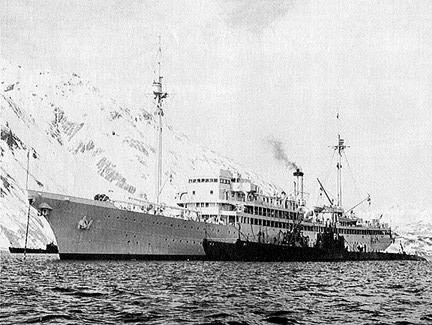
In the picture above you can see the USS Holland as she shepherded her "little chicks" from the North Atlantic to the North Pacific.  The mountains in the background are "small" by Alaskan standards.  Juneau and much of the towns on the Inside Passage have fjord like mountain ranges between 4-6 thousand feet.  These mountains have very steep slopes from sea level up to their peaks.


The Barracuda (SS-163) in Gastineau Channel in 1933
[borrowed from this page with a wide range of photos from 1930-1940s era submarines]

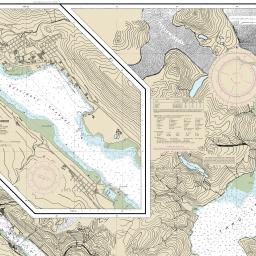
Nautical Chart of the Juneau area
Borrowed from NOAA
This link from a Juneau tourism website will provide some great info on things to do (when it comes to trail hiking and state or national parks Juneau.

You can also see some great Juneau photos, and shots from other parts of the largest state in the U.S.

The end of the road was also puzzling.  Juneau includes a small island (Douglas) and a larger chunk of the mainland.  There is a road covering each of those places, with a small bridge in between.  That equates to 4 ends of the road, since Juneau is landlocked.  Apparently this assumption was not correct.  The "end of the road" only explained the termination of the road south of the Ore House.
All the other "ends" had separate names based on other nearby landmarks.

Sheep Creek was a great fishing spot south of Juneau's downtown.  I assumed that its name was related to frequent visits of sheep, but these animals are not usually interested in being so close to the pesky humans at sea level.  The river was named after Sheep Mountain further into the valley.

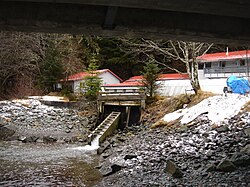
Sheep Creek Salmon Hatchery
(borrowed from Wikipedia  - Wiki link )
Near the hatchery above I caught my first fish on a wet fly.  It was a lovely Dolly Varden with its mouth full of salmon fry.


I later learned that those white spots representing some land mammals that I often saw up near Mount Roberts or the Mendenhall Glacier were actually mountain goats rather than Dall's sheep.  The sheep do not live in the Southeast portion of Alaska (often called the pan handle).  They also prefer a drier climate, which you cannot find in the Tongass National Forest.  This is a temperate rain forest which makes the Southeast area of Alaska very moist and sustains the snow capped mountains throughout the year.


So before you name something, think about the hidden meaning of those words.


Monday, May 26, 2014

Crushers versus Rippers

[All the thoughts expressed in this blog are completely my own, and most likely are not backed by scientific discovery in any possible way.]

I find it very interesting to learn about the way that some animals are more asymmetric than you would imagine.

Take humans as a first example.  Most of us have a lot of body parts of two when we are born:  two arms; two legs; two eyes; etc.   We have a few parts of one, but I think they are outnumbered by all of the pairs.  We also have some organs which have a pair or are separated into two lobes.

When we use these pairs to work, we eventually develop a dominant side.  This side is the one which allows us to make physical motions in the most efficient manner.

Many of us have watched toddlers try and catch, throw or hit a ball.  When you throw the ball in the air, after considerable repetition, most toddlers will develop a dominant side.  They catch the ball with one hand, and they may even throw it back with the same one.  If you start tossing them a ball to hit with one of those huge plastic bats, the parents may position the child in their dominant batting stance so they can guide them from behind, showing them how to swing so they will be able to hit a few balls.  If that doesn't work, they may eventually switch to the other side in an attempt to increase the likelihood that the child has more consistency in hitting the ball.

I myself am right side dominant.  I can accomplish tasks more powerfully when I approach them from a right side perspective.  I throw right handed, I usually bat right handed, I golf right handed, and my dominant leg is the right one when I play soccer.  However, I am left eye dominant in several situations such as when I bat lefty, kick with my left foot (quite useful when playing any position), and I can throw with my left hand, but without very much power.  There is as much accuracy, but not very much UMPHOOF. 

I did not do any real shooting before I joined the military, but the instructors told me pretty quickly that my left eye was the one that needed to do all the aiming.

When using the pistol I tried to follow their guidance on shutting my left eye to align the target with the sights on the gun, but I could not hit center mass.   They gave me a cardboard cylinder from a paper towel roll and had me look through the cylinder towards the target with both eyes open.  The target was rather fuzzy, but I could see it.  First they told me to close my left eye, which is quite difficult for me to do without scrunching up my face into a Popeye-like squint.  The target had disappeared, and the facial muscles in my cheek were exhausted from the efforts.  Then I repeated the process with my right eye closed, and I could see the target clearly.  Shooting with my right eye closed increased my accuracy, and was less difficult for my right cheek muscles to accomplish.  The rifle was a whole different story, as I had to shoot with my left hand, but I did qualify.

Back to the connection to the sea you all have been waiting for.  My grandparents lived on an island, and my brother and I both inherited our grandpa's love of the sea.  He started fishing as a teenager, and continued this practice for 60 more years.

When they retired, my grand parents moved to the small summer home they built on an island. Grandpa got a non commercial lobster license that allowed him to put out ten lobster pots. 

We would help him to harvest the lobsters and rebait the pots before he threw them back in the water.  When we ate our luscious dinner later that night, I wondered why the crusher claw tasted so good while the other claw was chalky and distasteful. The claw with more powerful muscles was the crusher, while the chalky one was meant for more deliberate and delicate work. 

I am not a biologist, so I don't know the full story on why these critters have such a profoundly asymmetrical development, but I do know that it results in two large claws with very different jobs (unlike its caribbean cousin).  The lobsters in the tropical climes have much larger tails, less prominent claws and giant antennae, which you can see in the link above.

I would imagine that the left eye dominant critters have the crusher on the left side when viewed from above, while the right eye dominant mud bugs display their crusher on the right. 
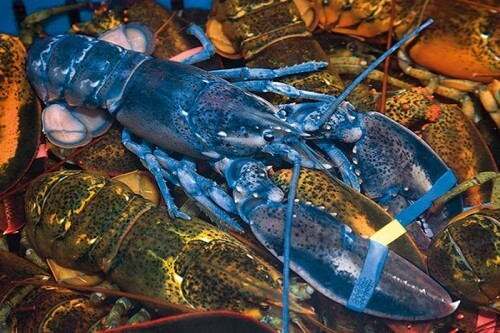
This photo shows a live blue lobster on top of his other North American Lobster friends.

But our northern mud bugs have different claws designed for different purposes.  The beautiful blue baby pictured above is a left hander.  You can tell this by the shorter but more bulky left claw.  This appendage is the crusher.  It has more power because it has to hold on to its prey.  The right hand claw is the ripper.  It shreds the food into edible sized pieces.

In my personal and professional relationships, I am perpetually the crusher. When you need someone to bring the hammer down, bring in the crusher.  If you need a bulldog to fix something quickly, bring in the crusher.  If you need to have a detailed analysis completed very thoroughly, the crusher is the best choice.  
If you want something done which doesn't require the wrecking ball mentality, you need the ripper. Rippers are the more delicate and deliberate partners. They work slowly and methodically. 

Wednesday, January 1, 2014

Maps, charts and turtle parts

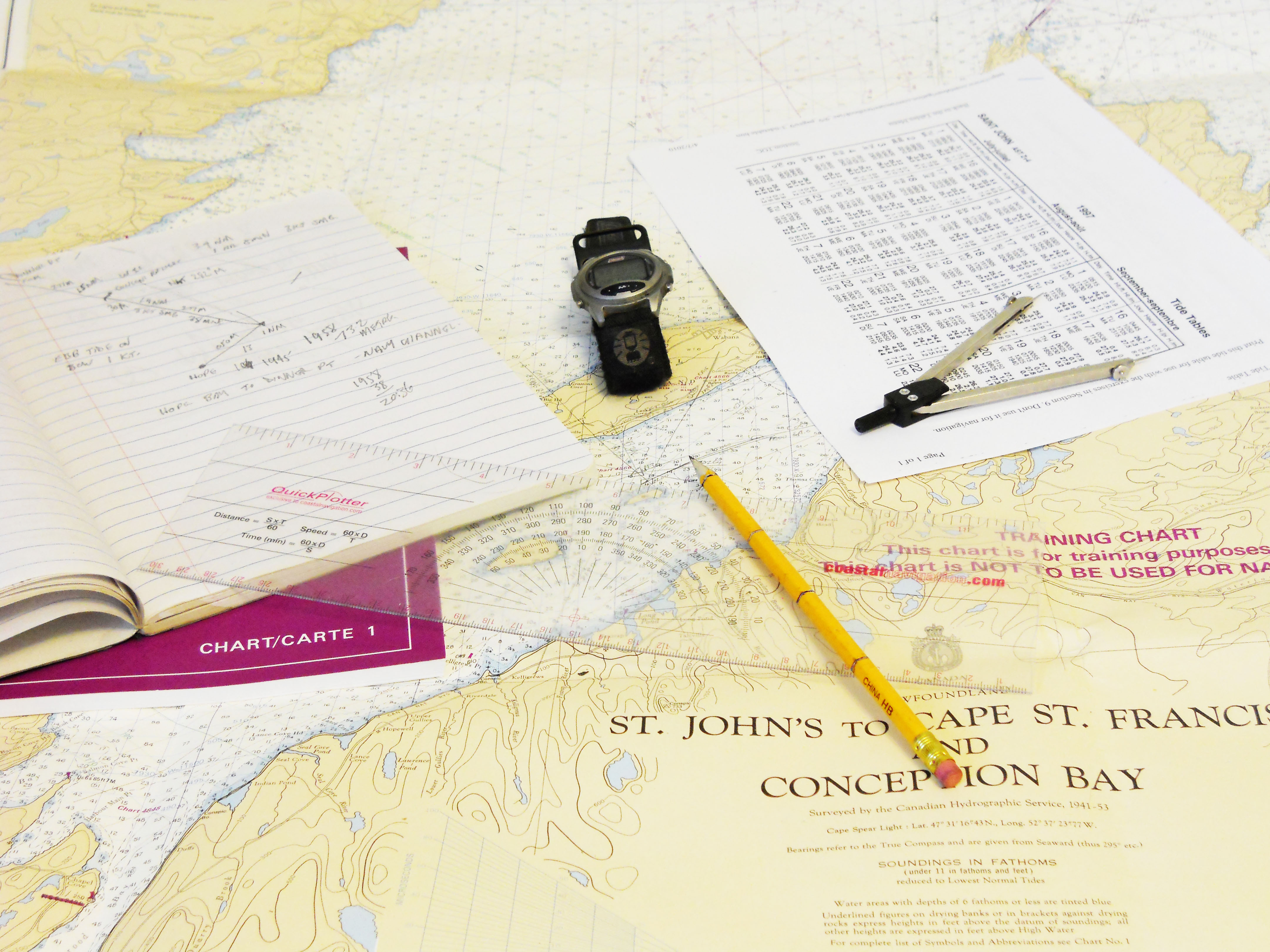
I suppose that I have spent most of my physical life on solid ground, but my heart and mind are normally floating around somewhere near the sea.  I have been trying to organize my home office, and I have been coming across quite a few charts.  No, these are not the charts that come in graph, pie, or bar form (though I do have quite a few of those too, displayed inside books or papers), but the big paper ones filled with pencil marks, contour lines, hydrographic information and buoy characteristics.

[borrowed from wikimedia]


My husband is more connected to mountains that provide skyward contour information, but the tools used to navigate on both are similar.

[borrowed from http://www.chugachwildernesslodge.com/images/TopoMap.jpg]


You need to measure things, so that you know how far that you have traveled over a certain time period.

[borrowed from http://www.waterencyclopedia.com/images/wsci_03_img0369.jpg]

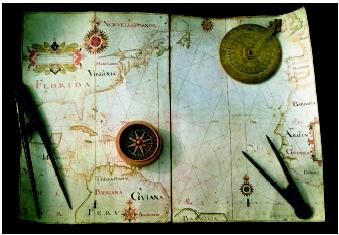
You need to be able to use a compass to identify high structures.

[borrowed from http://gruenagency.com/wp-content/uploads/2013/10/compass-old11.jpeg]


You need range information (such as maritime ranges or lining up certain mountainous or man made structures), so you man make sure that you are on the right course.

The turtle parts mentioned in the title have to do with my prefered next turtle acquisition, the beautiful map turtle.  Of course, I think it should be called the chart turtle, but you cannot win every fight, right?

[borrowed from http://www.theturtlesource.com/turtleContainer/Orange%20Miss%20map%20A(2).jpg]

Monday, December 30, 2013

Stuck for the holidays 2013

I know that everyone has different holidays, but the December one has brought an interesting story from the Antarctic region.  There are a huge number of stories on the web about the ongoing rescue efforts in the ice.  One of the best collection of these stories can be found on the link below.

BBC story on the plight of the Academician Shokalskiy


borrowed from http://news.bbcimg.co.uk/media/images/71975000/jpg/_71975706_020448570-1.jpg
It has been my experience that icebreakers frequently get stuck in places by traveling too far in the wrong season, or breaking down in bad places.  The third option would be overstretching the bounds of the equipment or skills of the navigators on board.  I am now down there with them, so I am trying not to make any assumptions about this explanation for their current predicament.

Eventually they are going to have to get a bigger class icebreaker down there to get them out, something more like this behemoth.

borrowed from http://rt.com/files/news/21/06/b0/00/v-1.jpg
Another solution will be to evacuate the crew and passengers with helicopters once the snow and high winds subside.  It seems this morning that is the next course of action.

Being a retired USCG officer with a handful of years at sea, I can relate a few stories of traveling in the ice.  Some of these I have experienced first hand, and others I have learned in my studies of USCG history.  Those stories are going to have to wait for a further blog entry.